This book shows you exactly how they did it, and how the same shift can come to you, in weeks, not years.
"I've spent years doing the inner work. This was the first time something actually moved. Not shifted. Moved. I cried reading the introduction and haven't stopped thinking about it."
"I recognized myself on the first page. The good daughter thing. I've never seen it named so clearly. Something unlocked."
"I kept expecting another mindset book. This is something else entirely. It felt like being seen."
You have done the work. You've read the books, sat with the therapists, journaled the mornings, taken the courses. You've named your patterns with impressive precision. You understand why you do what you do.
And you are still standing in your own kitchen at nine o'clock at night, asking the same quiet question you've been asking for years. Is this it?
It doesn't feel like a crisis. It feels like a grey and persistent hum that never quite leaves you alone. You know what your attachment style is. You know which parent wounded which part of you. You know, intellectually, exactly why you keep getting in your own way.
And yet the email goes unsent. The conversation stays rehearsed but unspoken. The business, the book, the thing you keep saying you'll start when you feel ready, keeps not starting.
"I know I'm self-sabotaging. I've known for years. But knowing doesn't seem to change anything."
"I feel like I've done everything right and I'm still exactly where I was."
"Sometimes I think the problem isn't that I haven't worked hard enough. It's that I've been working on the wrong thing."
If those sentences sound like the inside of your own head, you're not broken. You're not lazy. You're not insufficiently committed to your growth. You've been handed tools built for a different floor than the one where the actual problem lives.
You've been handed tools built for a different floor than the one where the actual problem lives.
The belief most of us carry is that readiness arrives before action. That the fear settles first. That healing happens, patterns clear, and then, finally, from a place of wholeness, we step forward into the thing we've been waiting to do. This feels reasonable. It feels responsible, even. Why would you move before you're ready?
Here's what that belief costs you. Every year spent preparing to feel ready is a year the readiness doesn't come, because readiness was never going to come first. The research that behavioural psychologist Albert Bandura spent decades building shows something most self-help won't say plainly: confidence isn't a feeling you manufacture in advance. It's evidence you collect after the fact. It grows from doing hard things and surviving them, not from feeling prepared enough to try.
Which means the waiting isn't caution. It's a bet on something that won't arrive on schedule.
The pattern looks like diligence. More therapy, more journaling, more understanding of why you are the way you are. Each brings insight. Each gives you a hit of progress. And each leaves you, a few weeks later, exactly where you started, because insight, however hard-won, is not the same as movement.
The tools you've been given are real. Therapy, journaling, courses, spiritual practice. Most of them work. They reach as far as they were built to reach, and then they stop at the same wall every time.
That wall exists because the thing running you doesn't live where information and insight do their work. It lives underneath, in a pattern your nervous system has been protecting as safety for longer than you've been alive.
You cannot affirm your way out of a survival strategy your body thinks is keeping you alive. You cannot think your way out of something that doesn't live in your thoughts. The pattern is not asking to be fixed or optimized. It's asking to be witnessed, which is something no book or course or solo journaling practice can do alone, because witnessing is relational by nature.
This is why you can describe the pattern in articulate, devastating detail on Tuesday and still find yourself inside it on Saturday night. Understanding and release are not the same act. Most of what gets sold as personal growth quietly confuses one for the other.
Marcela Escandon spent almost a decade inside a marriage her nervous system recognized as home, because home, for her body, had always meant a particular flavor of chaos. Smart, self-aware, well-read, she could trace the pattern. She understood it. She sat with enough therapy to write a thesis on her own psychology. She still couldn't leave.
Not for lack of courage or insight. Because the understanding, however clear, never reached the layer that was actually running the show. The layer that felt familiar with love confused, that coded smallness as safety, that had been making decisions on her behalf since long before she had the words for any of it.
The turning point wasn't a revelation. It came through collapse, through grief, through a miscarriage that cracked open something she hadn't known she was carrying. When she finally filed for divorce, she spent five months still living under the same roof, knowing what she needed to do, fear doing what fear does.
And somewhere in those months, she kept returning to her grandmother, a woman living in Colombia while Marcela was in the United States, a woman she couldn't drive to and sit with. And yet she felt her near. Intimately present.
That night, sitting with the grief that had traveled through her lineage for at least three generations, something loosened that years of therapy had never reached. Not shifted. Not reframed. Loosened. The way a knot loosens when you stop pulling on the rope.
The realisation that changed everything was this: what she had been trying to fix was never hers to fix. It was hers to witness. And the moment she stopped trying to repair herself and started honoring what the women before her had never had the safety or the time to feel, things began to move in weeks that hadn't moved in years.
She built a practice around what she learned. She left the marriage. She made her own money. She stopped bracing when the phone rang. The joy she'd been waiting to feel on the other side of all that self-improvement finally arrived, not from more insight, but from somewhere insight was never built to reach.
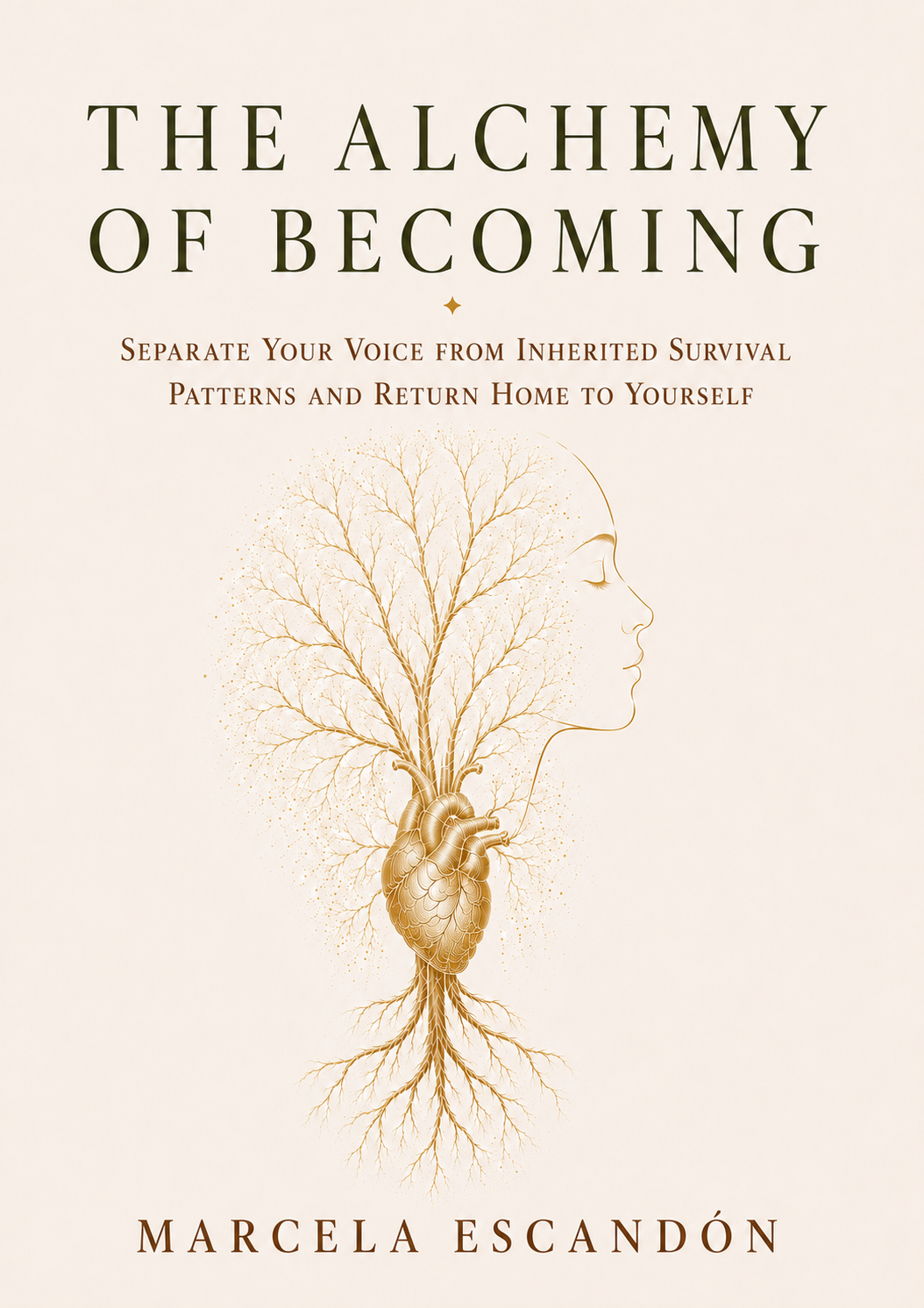
Becoming isn't forced. It's uncovered. Not through more understanding of yourself, but through witnessing what was handed to you, feeling it all the way through, and learning to tell the difference between the voice that's keeping you safe and the voice that's keeping you small.
Think of pain moving through a family the way a current moves through water. It doesn't ask permission. It doesn't pause at generational boundaries. It moves, and it keeps moving, until someone in the lineage has the capacity to stop, turn toward it, and feel it all the way through. Most of the women in your lineage didn't have that capacity, not because they were weak, but because they were surviving. They compartmentalized. They kept moving. And the feeling moved with them, into whoever came next.
By the time it reaches you, it has traveled a long way. It is tired. It is looking for somewhere to land. You are the one with the time, the safety, and the resources to land it.
This book introduces what Marcela calls Ancestral Discernment Work, a blend of psychology, human behavior, and ancestral wisdom that does something most self-improvement was never designed to do: it takes you to the floor beneath where insight and information work, the floor where the inherited patterns that are actually running your life have always lived.
In plain language, it teaches you to tell the difference between what's yours and what was handed to you. Between fear that's wisdom and fear that's an old survival pattern wearing a new outfit. Between a desire that belongs to you and an obligation that belonged to your great-grandmother and somehow ended up on your shoulders.
Then it asks you to act on what you find, because witnessing without follow-through stays in the ether. The whole framework lands in your actual life, in honest conversations, in boundaries that are finally yours, in the thing you keep saying you'll start when you feel ready.
If something in you has been quietly saying yes while you've been reading this, let's have a conversation about the book.
These are not steps to climb. They're a rhythm to learn, and you'll move through them more than once. Marcela calls them movements because becoming is alive, not linear, and every return brings you closer to yourself than the one before.
"I've spent years doing the inner work. This was the first time something actually moved. Not shifted. Moved. I cried reading the introduction and haven't stopped thinking about it."
"I recognized myself on the first page. The good daughter thing. I've never seen it named so clearly. Something unlocked."
"I kept expecting another mindset book. This is something else entirely. It felt like being seen."
One of Marcela's clients came to her having done all the right things: courses, books, therapy, years of genuine investment in her own growth. She had a business she believed in and a quiet, persistent pattern of making herself unfindable. Every time visibility was required, posting, reaching out, getting on a call, a reason arrived. She was protecting her nervous system. She wasn't subscribing to hustle culture. She was in a receiving season.
Every phrase was true in the abstract. And underneath all of it, her business was quietly disappearing because no one knew she existed.
Three months later, in their final session, Marcela was sitting across from a different woman. Not a more polished version. A settled-into-herself version. She was clearer when she spoke. She held her own ideas with weight. She'd had conversations she'd been avoiding for years and discovered she survived them. Her business had moved. The energy she'd been spending justifying her hiding was now available for living.
That's what becomes possible when the thing that's actually running the show finally gets witnessed.
"Marcela made me feel deeply seen and safe from the very first session. Her guidance helped me reconnect with myself in a way I hadn't experienced before."
"One of the greatest gifts of working with Marcela was learning to honor what I truly needed without guilt. That alone changed everything."
"I came looking for help with my business and discovered I actually needed something much deeper. That shift gave me the clarity I needed to move forward."

Marcela Escandon is a Colombian-born ancestral mentor who works at the intersection of psychology, human behavior, and ancestral wisdom. Her work is rooted in her own lived experience: nearly a decade inside a controlling and verbally abusive marriage, years of doing every form of personal development available, and the slow discovery that none of it reached the layer that was actually running her life until she stopped trying to fix herself and started witnessing what she'd inherited.
She built her practice around what she found on the other side of that shift: a framework for helping women separate their authentic voice from inherited survival patterns, and the courage to act before they feel ready. She works primarily with women in transition, women rebuilding identity and livelihood from the inside out, immigrant women, Latinas, and women leaving dynamics of coercive control who deserve a guide who has been somewhere recognizable.
Her mission is straightforward. She wants women to stop carrying what was never theirs to carry, and to build a life and a business their soul actually recognizes. She is, in her own words, still a student. A decade into the work, learning the lineage, finding gifts she didn't know were there. She believes that's the only reason she can be trusted to walk anyone else through it.
The book is the first step. Let's have a conversation and get it into your hands.